반응형
If the last chapter had us breathing in the salt air of the Mediterranean, today we're heading back south to Aswan, to dig up the real treasures the desert has been hiding all along. Care to come along?
This morning, what came out of the suitcase was a thin linen shirt and a wide-brimmed hat — a different kind of outfit altogether, suited to the dry, biting sun of the desert rather than Cairo's humid heat.
My husband, as always, strapped on his watch and pulled on his worn worker boots, grumbling as he did. "I reckon Egyptian sand's eaten these boots alive by now." He had absolutely no intention of taking them off, though.
Waiting for us at Aswan train station was Omar. An older man, gruff from the first hello. "You're late, " was all he said. But then he reached out to take our bags before we'd even asked, and something about that gesture suggested a much warmer man underneath the blunt exterior.
The Black Gift the Nile Left Behind
Silt — the Soil That Fed a Civilisation
Following Omar down to the riverbank, the colour of the ground beneath our feet had clearly changed. Black, soft soil.
"This is kemet, " Omar said, scooping up a handful. "It means 'black land.' That's where the name Egypt actually comes from."
I crouched down and ran the soil between my fingers. Remarkably fine grains. It was the result of volcanic sediment, carried thousands of kilometres downstream from the source.
Geologists studying the mineral content of this layer have found the soil was rich enough to withstand thousands of years of repeated farming, no artificial fertiliser required.
My husband muttered beside me, "So this is basically the world's oldest organic farming method." Omar cracked his first small smile.
A Chance Discovery
While running my fingers through the soil, something caught the light. A tiny fleck of mica. "Look, there's something shiny in here!" I called my husband over, and Omar leaned in to check, then nodded.
"That's fallen off volcanic rock further upstream. Most tourists walk right past it — good eye." It wasn't much of a find, really, but somehow it felt like holding the river's whole long journey in my hand.
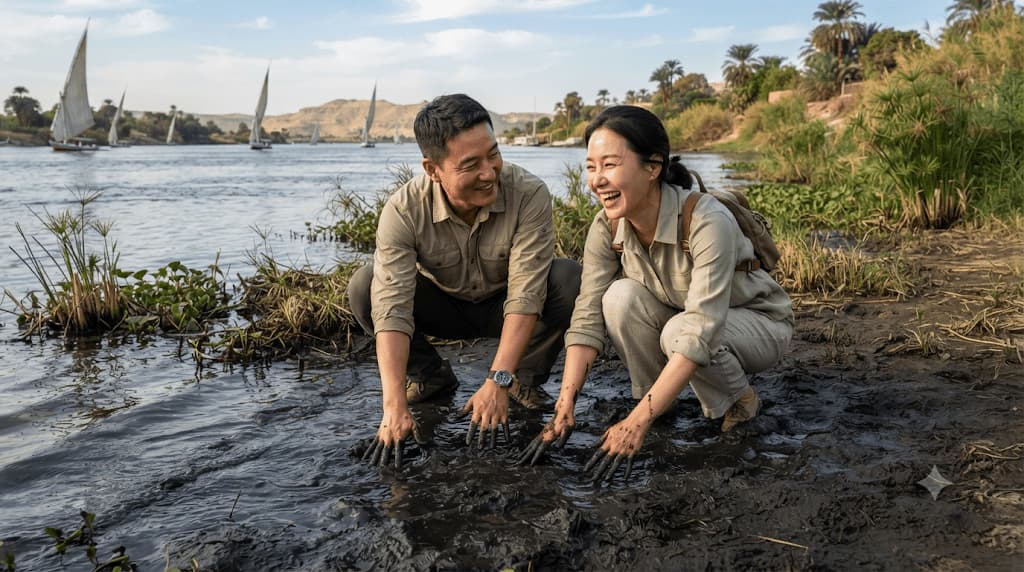
(The couple, dressed in safari shirts, touching the black silt along the Nile riverbank, 8K photorealistic)
The Granite Quarry — Skill Carved Into Stone
An Unfinished Obelisk, Still Lying There
Omar's next stop was an ancient quarry.
Lying right there, astonishingly, was a massive obelisk that had never been finished. Known as the Unfinished Obelisk, stretching some 42 metres long, it's believed to have been abandoned after cracks appeared partway through cutting.
"A failure is actually the best kind of evidence, " Omar said, running his hand along the stone's surface. With a finished obelisk, he explained, you can only guess how it was made. But this unfinished one shows you the entire process, exactly as it was left.
Regular grooves ran along the surface — marks left from repeated strikes with hammers made of stone even harder than the granite itself.
What the Granite Actually Is
Geologically, Aswan granite forms deep underground as magma cools slowly over time, known for its large, tightly packed crystals and remarkable hardness.
That hardness is exactly why the surface has barely worn down, even after thousands of years. My husband ran his hand over the stone.
"So these people deliberately picked the hardest rock around and went for it anyway." Omar actually laughed out loud this time. "Exactly right. These people never took the easy road."

(The couple standing beside the Unfinished Obelisk with their guide Omar, 8K photorealistic)
The People We Met at the Market
An Overconfident Gemstone Seller
On the way out of the quarry, a trader approached us holding out a reddish stone, calling it "genuine Egyptian carnelian.
" He winked, lowered his voice, and whispered "special price, half off, just for you" — and there was something almost endearing about how theatrical he was about it.
Omar murmured beside us, "That's just coloured glass. Nobody sells the real thing like that." We laughed and moved on, and the trader didn't miss a beat, repeating the exact same pitch to the next tourist.
A Boy Watering His Camel
Near the market entrance, a young boy was giving his camel water. While the camel drank, he hummed something quietly under his breath — but the moment our eyes met, he stopped, looking a little embarrassed, and flashed a grin instead.
That tiny moment stuck with me longer than it probably should have.
Another Treasure of the Desert — Gold
Gold From the Nubian Desert
Omar's final stop was a small museum, home to jewellery ancient Egyptians had crafted from gold mined in the Nubian desert.
"Some scholars think the name Egypt itself might come from a phrase meaning 'land of gold, '" Omar told us.
Research into ancient mining records backs this up — Egypt is believed to have held more gold than any other nation in the Mediterranean world at the time.
This gold wasn't just decorative. It served as serious leverage in diplomacy and trade with neighbouring powers.
A Desert Night, Just for Us
Beneath the Stars
That night, Omar offered us something special — a night camping right in the middle of the desert. "The stars out here are nothing like what you see in the city, " he said. He wasn't exaggerating.
Sitting side by side by the campfire, we looked up at a sky packed edge to edge with more stars than we could count. My husband put his hand on my shoulder. "This soil, this stone, this gold — all of it was made under this exact same sky." I didn't say anything back. Just nodded.
Resource tourism around Aswan is playing an increasingly important role in southern Egypt's economy. The ancient quarry sites and desert camping industry have become a new source of livelihood for local guides like Omar and the small tour operators working alongside them.

(The couple sitting by a desert campfire under a sky full of stars, 8K photorealistic)
[Today's Egypt Data — Episode 1, Part 8]
Main composition of Nile silt: volcanic mineral sediment from upstream
Length of the Unfinished Obelisk: approximately 42 metres
Ancient Nubian gold mining: believed to be the largest scale in the Mediterranean world
[Couple's Discovery Notes]
Husband's one-line verdict: "In this country, not even a handful of dirt is just dirt."
Today's biggest surprise: an unfinished obelisk reveals more about ancient construction technique than a finished one ever could
Tomorrow's task: exploring traditional Egyptian art and hieroglyphic technique
[Disclaimer]
This post draws on research into Egyptian geology and ancient mining, though the travel episodes, characters, and dialogue have been adapted for readability.
Specific statistics are for reference only and may vary across academic sources.
[Travel expert's one-line comment]
"Egypt's real treasure might not be the gold itself, but the sheer persistence of the people who dug it out." — drawing on Egyptian geo-archaeological research
주소 (골뱅이) gmail (닷) com
반응형