반응형
If the last chapter had us at a temple on the desert border, today we're heading to a city that faces the Mediterranean — Alexandria. Care to come along?
Getting from Abu Simbel to Alexandria, via Cairo, took the better part of a full day. Watching out the train window, the desert slowly turned green, and then, all at once, a salty sea breeze rushed in. Our new guide, Layla, met us at the train station.
"This is Egypt, but it doesn't really feel like Egypt, does it?" she said with a smile. She was right.
Searching for a Library That No Longer Exists
The Greatest Repository of Knowledge in the Ancient World
Built in the 3rd century BCE under the Ptolemaic dynasty, the Library of Alexandria is said to have once held more texts than anywhere else in the ancient world.
Scholars point to records claiming that every ship passing through Alexandria's harbour had its books confiscated, copied, and returned — a striking hint at just how much knowledge this library managed to pull together.
Layla stopped walking and pointed out toward the sea. "It would have stood somewhere near where we're standing right now. Exactly where, though, is still debated.
" Beyond the fact that it was lost to fire, or perhaps to repeated waves of political upheaval, even its final fate has never been clearly established. There was something oddly hollow about that, but strangely compelling too.
A Modern Library, Standing Nearby
Not far from that same spot stands the Bibliotheca Alexandrina, completed in 2002.
This vast disc-shaped building was an attempt to bring the spirit of the ancient library into the modern era. The architects angled the entire roof to draw in indirect sunlight — a calculated choice meant to protect the books from direct light while still making the most of natural illumination.

(Exterior of the Bibliotheca Alexandrina with the Mediterranean Sea in the background, 8K photorealistic)
Chasing the Traces of the Pharos Lighthouse
One of the Seven Wonders of the Ancient World
We followed Layla to Qaitbay Citadel. What stands there now is a sturdy 15th-century fortress, but this same spot once held the Lighthouse of Alexandria, ranked among the Seven Wonders of the Ancient World.
Estimated at over 100 metres tall, this lighthouse guided ships across the Mediterranean for centuries.
Fragments Sleeping Beneath the Sea
In the 1990s, an underwater archaeology team discovered massive stone blocks off this coast, believed to be remnants of the lighthouse.
Underwater scanning confirmed some of these blocks weighed tens of tonnes. Layla looked out over the water and said, "Somewhere down there, part of the lighthouse is still resting." Listening to the waves as she said it, something about that thought settled quietly in my chest.

(Qaitbay Citadel and the Mediterranean Sea, the couple viewed from behind, 8K photorealistic)
The People We Met on the Waterfront
A Fisherman Mending His Nets
On the beach near the citadel, an older fisherman sat quietly mending his nets. We gestured to ask if it was okay to take a photo, and he simply nodded and kept working.
He didn't say a word, but that one unbothered gesture somehow captured Alexandria's whole laid-back mood.
A Shell-Necklace Seller Who Kept Raising His Price
Along the beach promenade, a young boy was selling shell necklaces. He named a fair price at first, but the moment we said we'd buy one, he doubled it on the spot. Layla said a few quiet words to him, and he dropped it back to the original price with a sheepish grin.
"Kids do that everywhere, " Layla said, laughing. We couldn't help laughing along with her.
What We Talked About, Facing the Mediterranean
An Evening With the Sound of the Waves
That evening, we sat at a small beachside café and looked out at the Mediterranean. The air felt completely different from Cairo's desert.
My husband looked out at the waves and said, "This city feels like a city of lost things. But strangely, it doesn't feel sad." I felt exactly the same way. The lost library, the sunken lighthouse — somehow, in this city, none of it felt like loss so much as something left behind, still present in its own way.
Alexandria's tourism industry holds a distinctive place within Egypt's largely Cairo-centred travel landscape.
Thanks to its identity as a Mediterranean coastal city, the livelihoods of guides like Layla, beachside traders, and local fishermen are all bound up with this city's historical character.
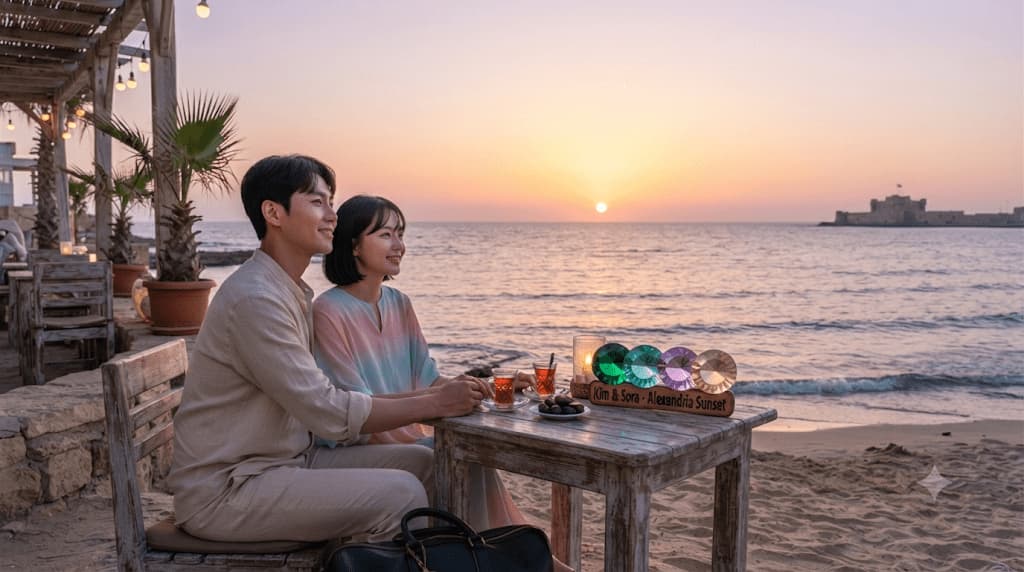
(The couple gazing at the Mediterranean Sea from a beachside café in Alexandria at sunset, 8K photorealistic)
[Today's Egypt Data — Episode 1, Part 7]
Library of Alexandria founded: 3rd century BCE, under the Ptolemaic dynasty
Bibliotheca Alexandrina completed: 2002
Estimated height of the Pharos Lighthouse: over 100 metres, one of the Seven Wonders of the Ancient World
[Couple's Discovery Notes]
Husband's one-line verdict: "Alexandria is a city where even the lost things stay beautiful."
Today's biggest surprise: fragments of the Pharos Lighthouse are still resting under the sea today
Tomorrow's task: exploring the Nile's natural resources and the desert's mineral wealth
[Disclaimer]
This post draws on research into the Library of Alexandria and the Pharos Lighthouse, though the travel episodes, characters, and dialogue have been adapted for readability.
The exact location of the ancient library and the circumstances of its loss remain a topic of ongoing academic debate.
[Travel expert's one-line comment]
"Alexandria might be the one place in Egypt where loss itself has become part of the identity." — drawing on Mediterranean archaeological research
주소 (골뱅이) gmail (닷) com
반응형