반응형
If the last chapter had us leaving the Valley of the Kings, today we're heading to the very edge of southern Egypt, near the border, to Abu Simbel. Care to come along?
The flight from Luxor to Abu Simbel takes about an hour, leaving early in the morning. We were still a bit sad to say goodbye to Fatima, but a new guide, Yusuf, was waiting for us at the airport. "Not many people make it all the way out here, " he said with a smile. "That's exactly what makes it special."
Giant Faces Beside Lake Nasser
A Temple Carved Straight Into the Mountain
We stepped off the bus and started walking, and the second we rounded a corner, the breath just left me.
Four colossal statues, each over 20 metres tall, sat side by side, carved into the mountainside. The face of Ramesses II, repeated four times. This wasn't a building. It was a mountain, carved into something else entirely.
Around 1264 BCE, Ramesses II is said to have built this temple with two goals in mind at once — a bold warning to Nubia, Egypt's neighbour to the south, and a way of carving his own permanence into stone. Yusuf lowered his voice as he spoke. "There was a time when power only lasted if you cut it into rock like this."
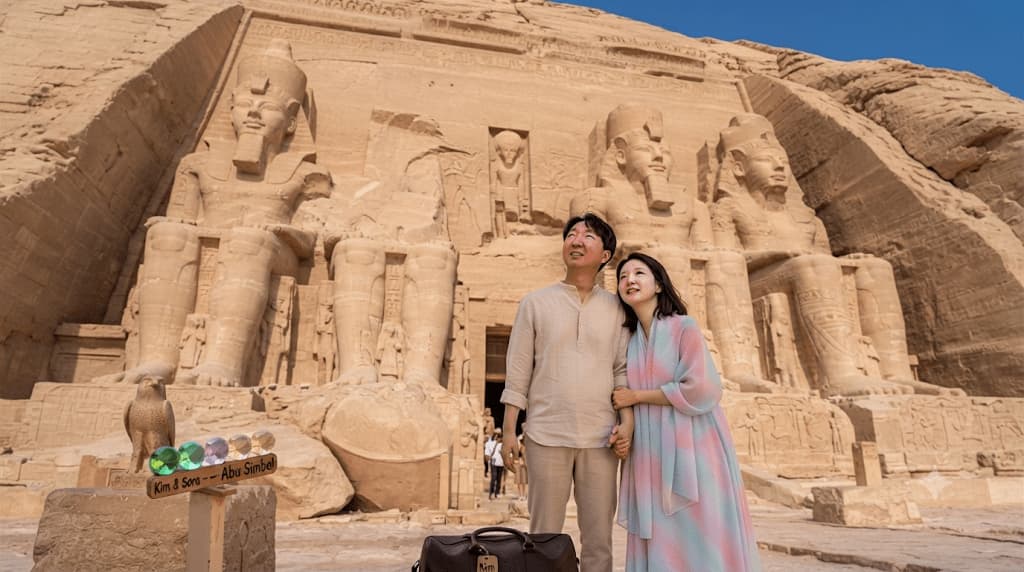
(View of the Great Temple of Abu Simbel with four colossal statues of Ramesses II, clear sky, 8K photorealistic)
The Days Light Reaches Deep Into the Temple
The Miracle of February 22nd and October 22nd
Stepping inside the temple, a cool darkness closed in around us. Yusuf lifted his torch toward the very back of the temple.
"Twice a year, morning sunlight reaches all the way in to touch the statues' faces." February 22nd and October 22nd. It meant ancient Egyptian astronomers had calculated the sun's path precisely enough to align the entire temple around it. Hard to believe that kind of precision was possible, back when they barely had any tools to speak of.
A Temple Moved, Whole
There was an even more astonishing part of the story. In the 1960s, the construction of the Aswan High Dam threatened to submerge this entire temple underwater.
UNESCO led an international rescue effort, cutting the whole temple into more than 1,000 blocks and reassembling it, piece by piece, at its current location — even reproducing the original astronomical alignment exactly. My husband murmured quietly, "So they basically moved an entire mountain." He wasn't wrong.
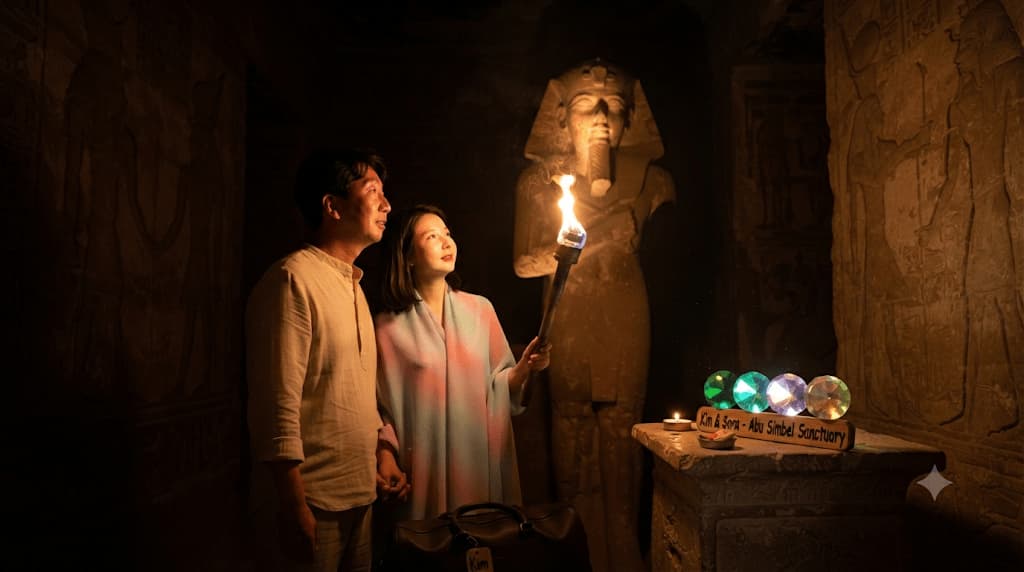
(Inside Abu Simbel temple, statues revealed by torchlight in the darkness, 8K photorealistic)
The People We Met Outside the Temple
A Traveller Sketching in Silence
On the temple steps, a Western woman sat alone, quietly sketching the temple into a notebook. When our eyes met, she just gave a small smile and said nothing more. There was something about that quiet focus that made the weight of this place feel even more real.
An Overly Persistent Souvenir Seller
Once we stepped outside, a vendor followed us, unrolling papyrus painting after papyrus painting to show us. "Special, only for today!" he kept saying, over and over, until we both burst out laughing. Yusuf said a few short words to him, and the vendor backed off with a sheepish grin. "He does this every time, " Yusuf said, shrugging.
An Evening at the Desert Border
Sunset Over Lake Nasser
That evening, we sat by Lake Nasser near the temple and watched the sunset. In that quiet spot, not far from the Egypt–Sudan border, my husband said, out of nowhere, "Like this temple — wherever life moves us, I reckon what we feel for each other stays exactly the same.
" It was a bit of a random thing to say, but it stuck with me long after.
Abu Simbel's presence contributes significantly to the tourism economy of southern Egypt, particularly the small border town of Aswan nearby.
The livelihoods of local guides like Yusuf, and the wider local economy that welcomes visitors willing to travel this far, all depend on this remote temple continuing to draw people in.

(The couple watching the sunset by Lake Nasser, 8K photorealistic, pastel orange sky)
[Today's Egypt Data — Episode 1, Part 6]
Great Temple of Abu Simbel built: around 1264 BCE
Solar alignment phenomenon: February 22nd and October 22nd each year
UNESCO relocation project: 1960s, cut into over 1,000 blocks and moved
[Couple's Discovery Notes]
Husband's one-line verdict: "Power fades away, but precision stays."
Today's biggest surprise: the entire temple was relocated and still reproduces its original astronomical alignment
Tomorrow's task: heading to Alexandria to trace the remains of the ancient library
[Disclaimer]
This post draws on research into Abu Simbel and its UNESCO relocation project, though the travel episodes, characters, and dialogue have been adapted for readability.
Dates for the solar alignment phenomenon can vary by roughly a day depending on the source.
[Travel expert's one-line comment]
"Abu Simbel sits further from everything else in Egypt, but it's also where you'll find some of the most precise calculations left behind by any ancient civilisation." — drawing on Egyptian archaeological research
주소 (골뱅이) gmail (닷) com
반응형