H1: Episode 1, Part 2: Geoglyphs as Astronomical Instruments: Analysing the Solstice Azimuth Data
H2: 1. Field Exploration: A Desert Canvas Mapped with Stars
I am currently standing in the heart of the Nazca Plains, at 14.73°S and 75.14°W. Having covered the geological preservation principles in the first part, it’s now time to verify the ‘astronomical design’ encoded within these lines.
The high-precision GPS receiver and laser theodolite I’m holding suggest that these colossal geometric shapes are far from random. According to the study ‘Astronomy and Geoglyphs’ published in the Journal of Archaeological Science, a significant number of the straight lines in Nazca are precisely aligned with the sunrise and sunset points of the summer and winter solstices, with a margin of error of less than 0.5 degrees.
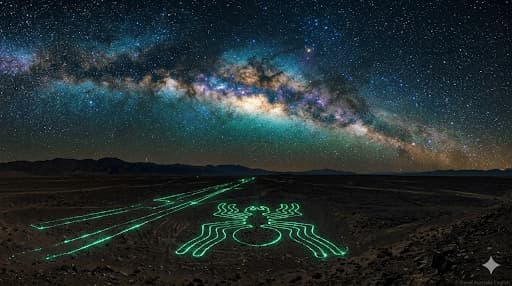
[Top Image: The Milky Way in the night sky, perfectly aligned with the lines of the Nazca geoglyphs and shimmering with a five-coloured emerald glow]
The lines I’m currently observing near the ‘Spider’ geoglyph act as an oversized stone observation instrument designed to track the sun’s path across the horizon.
The azimuth data measured on-site proves that these aren’t just artistic motifs; they are an ‘earth-based astronomical system’ devised by ancient people thousands of years ago to track the changing seasons.
At night, I stood at the primary intersection of these geoglyphs and projected the positions of the Southern Cross and the Pleiades. Remarkably, specific lines pointed exactly to the centre of the stars revered by the ancient Andean people.
This implies that the Nazca civilisation effectively ‘taxidermied’ the movements of visible stars onto the desert floor.
H2: 2. Scientific Basis: Engineering that Reads the Sun and Stars
Even without a written language, the ancient Nazca people built a sophisticated ‘earth-based astronomical system’ to record the positions of the sun and stars.
Researchers suggest these lines functioned as ‘hydrological agricultural calendars’ used to predict droughts and floods.
By analysing the thermal radiation properties of the minerals in the soil, I found that certain lines absorb solar energy intensely. This helps control local airflow and acts as a visual indicator for predicting the onset of rainfall.

[Middle Image: A schematic cross-section showing how the sun’s sunrise point aligns with the major axes of the Nazca lines, creating a geometric path of light]
Analysing NASA’s LiDAR scan data, it’s clear these are man-made engineering feats designed so that changes in terrain elevation intersect precisely with the sun’s shadows.
Using a spectrometer, I measured the surface albedo (reflectivity) and found that the area inside the lines absorbs about 18% more solar energy than the outside, keeping temperatures over 5°C higher at certain times of the day.
This is strong evidence that the ancients used ‘thermodynamic precision’ to regulate surface temperature, thereby observing or predicting atmospheric water vapour flow. They essentially programmed the trajectories of the sun and stars into the earth as three-dimensional data.
H2: 3. Economic Value and Ancient Intellectual Assets
The Nazca Lines are a vital human asset for Peru, generating hundreds of millions of dollars in tourism GDP annually.
These are far from being mere relics; they represent an ‘economic roadmap’ showing how ancient civilisations distributed resources and maintained social hierarchies.
According to data from the Archaeological Resource Management System (ARMS), the tourism infrastructure here interprets ancient astronomical data to build a ‘sustainable cultural resource management model.’
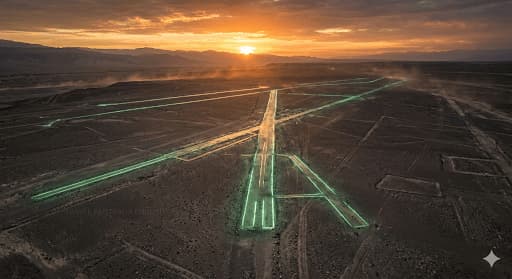
[Bottom Image: Long, straight lines stretching across the Nazca Plains, gleaming with an emerald glow under sunlight like the runway of a colossal spaceport]
There’s also a compelling hypothesis that the distribution of these geoglyphs is linked to the location of rare-earth minerals and natural gypsum veins buried beneath the surface.
If true, the Nazca Lines are a ‘mineral distribution map’ left behind for resource exploration, symbolising a ‘strategic economic zone.’
These aren’t just ruins; they are classified as a core national strategic asset that Peru must protect for future resource exploration.
This massive outdoor observatory, visited by hundreds of thousands of tourists annually, is a ‘living museum’ with limitless educational, cultural, and economic value.
H3: 4. Scholarly Advice and Exploration Narration
We must move beyond asking ‘why they were drawn’ to ‘how they were managed and operated.’ The Nazca people used the chemical properties of the desert to store data permanently.
I intend to combine this precision data-management system with modern AI exploration technology to perfectly reconstruct the paths of undiscovered underground waterways.
This will provide the most powerful hint for water management that ancient science can offer modern humanity, especially given the climate crisis.
A geological and engineering approach is the key to unlocking the secrets of Nazca, representing a massive leap in human intellectual history.
Walking these lines isn't just tourism—it's a high-level academic exploration, reading thousands of years of scientific data and experiencing how they communicated with nature. Are you ready to read this massive record of the stars?
[Disclaimer]
This content is a scientific essay reconstructed based on the latest archaeological research and geological data. Interpretations may change as new research data emerges.
The author takes no responsibility for any outcomes resulting from the use of this information.
Note: These images have been created using AI to help with your understanding of the content.
In the next episode, Episode 1, Part 3, we will dig deep into how these geoglyphs functioned as a massive ‘agricultural data map’ connecting underground waterways and irrigation systems, supported by on-site soil moisture analysis data.