Episode 2, Part 1: The Land Where Gods Once Walked — Ancient Greek History
Leaving Egypt's sand behind, we're crossing the Mediterranean now, heading to the land of myth and philosophy — Greece. Care to walk with us?
The moment we landed at Athens airport, what came out of the suitcase wasn't a linen shirt this time, but a slightly more casual cotton shirt and comfortable trekking shoes.
"Desert mode is officially over, " my husband said, packing away his worker boots. "This place needs mountain legs.
" He wasn't wrong — Athens turned out to be a city built almost entirely on hills and steps.
Our guide, Dimitris, met us at arrivals.
Silver-haired, with a well-groomed moustache, his opening line set the tone straight away. "Welcome to Greece. You might not believe in myths yet — but you will by the time we're done.
" A bit theatrical, sure, but there was something oddly convincing about his confidence.
A Barren Land That Raised a Great Civilisation
Why Greece, of All Places
On the walk up to the Acropolis, Dimitris stopped and gestured at the surrounding mountains. "Look at this land. Barely any flat plains, right?
Nearly 80% of Greece is mountainous terrain." Geologists argue this rugged landscape actually shaped ancient Greek civilisation in a unique way — rather than forming one unified empire across open plains, small independent city-states, or "poleis, " developed in valleys carved apart by mountains.
My husband caught his breath halfway up a steep incline. "So basically, the terrain forced these people apart." Dimitris nodded. "Exactly right. But that separation bred competition, and that competition is what gave rise to philosophy and art."
The Sea That Opened a Different Path
Where the mountains blocked land travel, the Aegean Sea opened up another way. With its famously complex coastline and countless islands, sailing was often faster than travelling overland across the Greek peninsula. Archaeologists believe this geography naturally turned ancient Greeks into skilled sailors and traders.
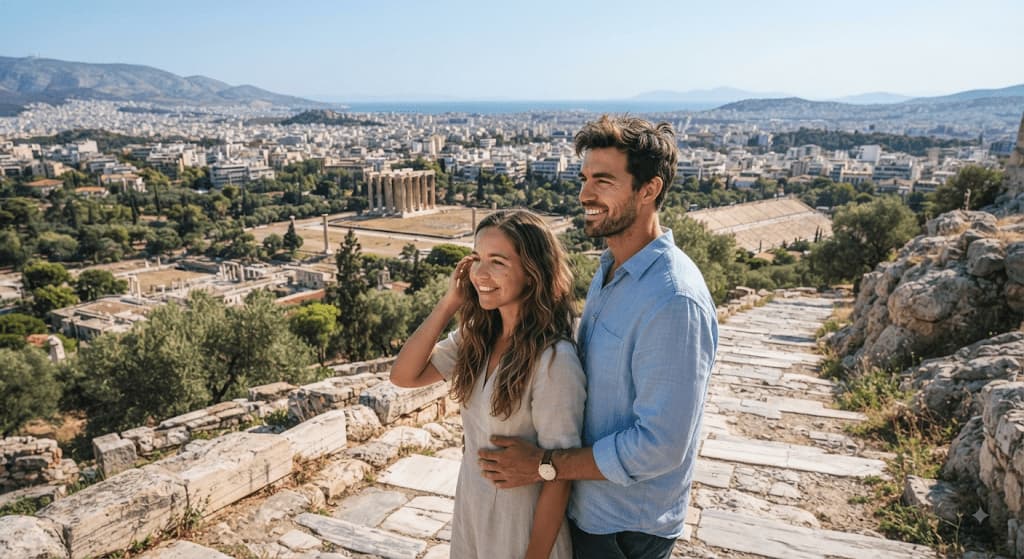
(The couple, dressed in cotton shirts, looking out over Athens on the path up to the Acropolis, 8K photorealistic. Characters: Kim — Australian woman, early 30s, shoulder-length wavy chestnut brown hair, warm hazel eyes, light tan skin, soft oval face, small beauty mark near left cheekbone, natural confident smile. Husband — Australian man, mid 30s, short tousled dark brown hair, light stubble beard, warm brown eyes, tall athletic build, friendly approachable smile.)
The Parthenon, an Obsession With Perfection
Architecture Built on Illusion
At the summit of the Acropolis, the Parthenon opened up before us. Dimitris pointed to one of the columns. "These look perfectly straight to you, right?" When we agreed, he grinned.
"Actually, they're not. Every single one curves ever so slightly."
Architectural historians explain that the Parthenon's columns aren't truly straight lines at all — they were deliberately curved so that they'd appear perfectly straight to the human eye.
This technique is called "entasis." A perfectly straight column, it turns out, actually looks slightly concave in the middle to our eyes, so the ancient builders subtly bulged the columns to cancel out that optical illusion.
A Detail We Noticed by Chance
Studying the temple floor closely, something felt off. "Wait — this floor doesn't look completely flat either, does it?" Dimitris turned, surprised. "That's right!
The centre bulges up slightly there too. Most tourists never notice that." He looked at me for a moment, genuinely impressed. It wasn't much of an observation, but for that moment, I felt like an actual architect.
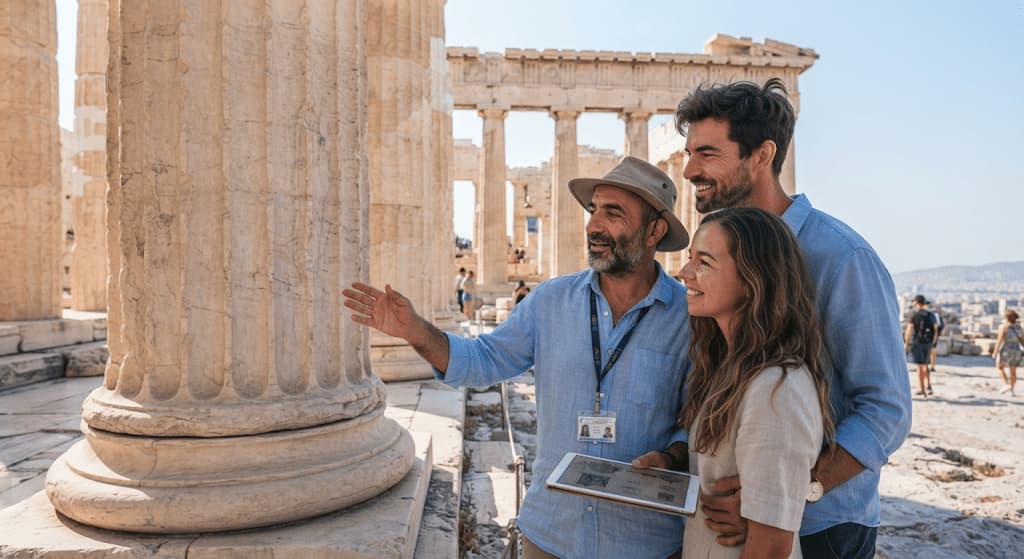
(The couple examining the columns of the Parthenon with their guide Dimitris, 8K photorealistic. Characters: Kim and husband fixed appearance as described above.)
The People We Met at the Agora
A Gruff but Warm-Hearted Potter
Coming down from the Acropolis, near the ancient Agora ruins, we found a small workshop where a potter was working his wheel. He didn't so much as glance at us as we approached — just kept spinning the clay.
But as we turned to leave, he suddenly pressed a small piece of pottery into my hand. "Take it. Call it your first gift from Greece." Gruff on the outside, but there was real warmth behind that gesture.
A Souvenir Seller With a Flair for the Dramatic
Near the Agora entrance, a trader approached us, waving a rusted piece of metal and insisting it was "a genuine ancient Greek coin.
" Eyes wide, voice lowered dramatically, he whispered, "Bought it off a museum staffer — don't tell anyone." His performance was so over the top we both burst out laughing. Dimitris shook his head beside us.
"That's just something from a souvenir shop. He does this every time."
On the Hill Where Myths Began
A Small Discovery of Our Own
That afternoon, Dimitris led us up to the Areopagus, a hill with a clear view over the Acropolis. Standing there, he lowered his voice.
"Couples sometimes make promises to each other up here. It's said to be a spot the gods watch over." My husband glanced at me with a playful grin, then suddenly turned serious and held out his hand. "Should we make another promise, right here?"
It carried a different kind of weight from our anniversary celebration in the Egyptian desert — something mythic about it.
An Evening Beneath the Acropolis Lights
When the City Starts to Glow
As the sun went down, the Acropolis lit up, casting a soft glow over the entire city. We sat at a nearby rooftop café, taking it all in.
My husband raised his wine glass. "This country's mountains and sea kept pulling people apart, and somehow, that's exactly what created something this beautiful." Dimitris overheard and smiled, satisfied. "Now you've truly understood Greece."
Tourism centred on the Acropolis and the Agora forms one of the core pillars of Greece's national economy. Guides like Dimitris, the potter, the souvenir sellers — all of them are part of what keeps this ancient hill alive today.
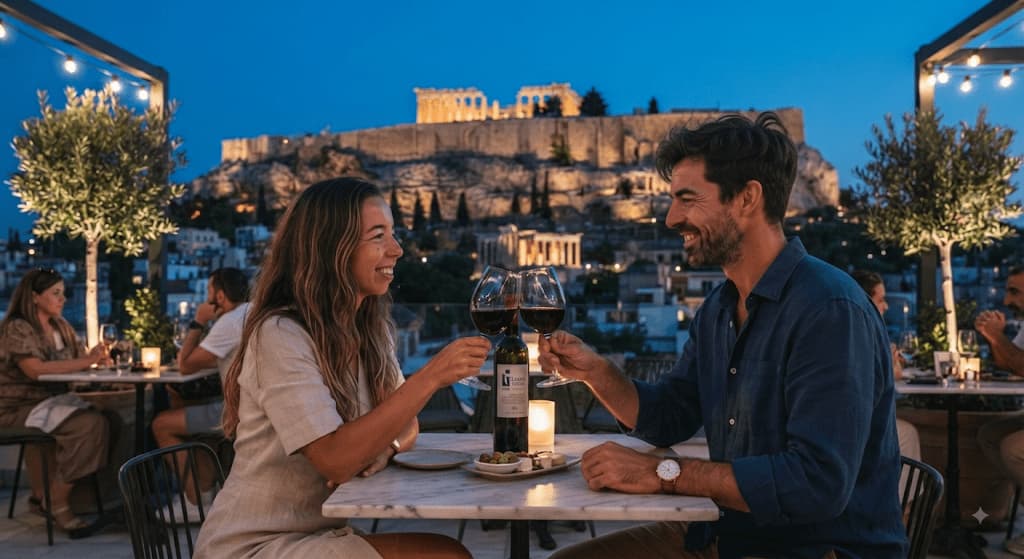
(The couple sharing wine at a rooftop café with the illuminated Acropolis in the background, 8K photorealistic. Characters: Kim and husband fixed appearance as described above.)
[Today's Greece Data — Episode 2, Part 1]
Proportion of Greece that is mountainous terrain: roughly 80%
Parthenon construction technique: "entasis" (subtle curvature of the columns)
Background to the formation of Greek city-states (poleis): geographic fragmentation caused by mountainous terrain
[Couple's Discovery Notes]
Husband's one-line verdict: "This country grew stronger precisely because it was pulled apart."
Today's biggest surprise: even the Parthenon's floor was built to correct an optical illusion
Tomorrow's task: exploring Greece's medieval and modern history, and the traces of the Byzantine Empire
[Disclaimer]
This post draws on research into ancient Greek history and architecture, though the travel episodes, characters, and dialogue have been adapted for readability.
Explanations of specific architectural techniques may represent one of several competing theories.
[Travel expert's one-line comment]
"The Parthenon gave up true straight lines in order to look perfect. There's something deeply Greek about that paradox." — drawing on ancient Greek architectural research
주소 (골뱅이) gmail (닷) com