Ancient Tech & Science
Episode 1, Part 10: Stories the Nile Told Us — Egyptian Folk Tales and Legends
Miss Mi-yeon
2026. 8. 12. 22:30
반응형
If the last chapter had us in the world of hieroglyphs and papyrus, today we're heading into the world Egyptians have been passing down for generations, story by story. Care to come along?
On our last morning in Cairo, what came out of the suitcase was just a thin scarf. Today wasn't about ruins or museums — we were heading to a small village along the Nile.
My husband, lacing up his worker boots as always, asked, "Where to today, then?" "To listen to stories, " I said. He tilted his head, curious.
We were welcomed by an elder from the village, an old man named Sayed. White hair, deeply lined face, but his eyes were unusually bright. He didn't waste words.
His first greeting was just one line. "Care for some tea?" But something in the way he handed over the cup carried the weight of someone who'd guarded these stories for a very long time.
The Story of Hapi, God of the Nile
A Time When the River Itself Was a God
By the time we'd finished our tea, Sayed began speaking, low and steady. Ancient Egyptians believed in Hapi, the god who governed the Nile's flooding.
Hapi carried both male and female traits, and represented abundance and fertility.
"Every year, before the flooding began, people would gather along the riverbank and make offerings to Hapi, " Sayed said, spreading both hands out toward the river.
"If the river didn't give itself, there'd be no harvest that year." Something in that single gesture made me feel this wasn't just a myth — it was a desperate, life-or-death belief.
A Connection We Stumbled Onto
Listening to his story, something clicked. "Wait — you told us about the nilometer earlier. Wasn't that basically another way of making an offering to Hapi?
" Sayed's eyes widened for the first time, and he looked right at me. "Exactly right. Measuring the water level was, in the end, another way of trying to read the will of the gods.
" It wasn't much of a connection, really, but somehow that small nod of approval felt oddly satisfying.

(The couple listening to Sayed's stories in a Nile-side village, warm afternoon light, 8K photorealistic)
Osiris and Isis, a Story of Love and Renewal
Love That Reached Beyond Death
Sayed's next story was of Osiris and Isis.
Osiris is killed by his jealous brother Set, his body scattered into pieces across Egypt — but his wife Isis searches the entire land, gathering every fragment, and brings him back to life.
"Sounds like a sad story, but it's really about hope, " Sayed said. "Just as the Nile dries up and floods again every year, Osiris dies and rises again.
People believed their own lives followed that same cycle."
My husband said quietly, "So for these people, the river was the god, and the god was life itself." Sayed nodded, and for the first time, gave a faint smile.
Where Geography Meets Story
Egyptologists have noted that this myth lines up almost exactly with the Nile's actual annual water cycle.
The period when the river runs dry (Osiris's death) and the period it floods again (Osiris's resurrection) closely match the events of the myth. In other words, the myth wasn't pure imagination — it captured the real, physical rhythm of the land itself.
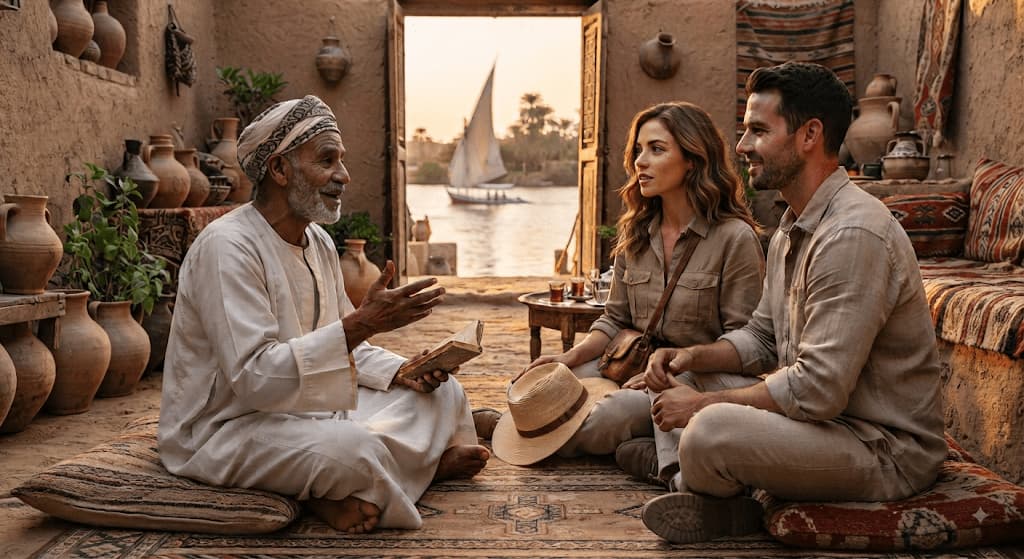
(The couple and Sayed talking while looking out at the Nile, 8K photorealistic)
The People We Met in the Village
Children Eavesdropping Through the Doorway
In a corner of Sayed's courtyard, a few local kids were secretly listening in through a gap in the door.
The moment our eyes met, they burst into giggles and ran off — only to creep back a few minutes later and press their ears to the same gap.
It felt like watching this story continue passing down, generation to generation, right in front of us.
A Cheeky Camel Trader
At the edge of the village, a man led a camel around, joking that it was "the very camel the gods used to ride." Obviously not true, but his deadpan delivery had everyone laughing.
Even Sayed shook his head at him while failing to hold back a smile. "That one's the village's other storyteller. He's just got a few more lies mixed in, " he said, and we all cracked up.
An Evening, and a Story We Now Carry
A Small Ritual of Our Own
As the sun began to set, Sayed handed us a small gift — a tiny figurine of Hapi, shaped from Nile mud.
"Now that you've heard the story, you're part of it too, " he said. My husband took the figurine and said, seriously, "We'll keep telling this story, wherever we go." Sayed said nothing back. Just nodded.
The oral storytelling tradition kept alive in villages along the Nile is more than cultural heritage — it feeds directly into small-scale local tourism and craft sales (Hapi figurines, traditional pottery), contributing to the village economy.
Storytellers like Sayed, the kids eavesdropping through the door, even the cheeky camel trader — all of them are part of what keeps the Nile's stories alive today.

(The couple holding a small Hapi figurine by the Nile at sunset, 8K photorealistic, pastel orange sky)
[Today's Egypt Data — Episode 1, Part 10]
The god Hapi: governed the Nile's flooding and abundance, embodying both male and female traits
The Osiris and Isis myth: symbolically tied to the Nile's annual water-level cycle
Oral folk tales along the Nile: still passed down between generations today
[Couple's Discovery Notes]
Husband's one-line verdict: "In this country, the river was the god, and the god was the story."
Today's biggest surprise: how closely the myth's events match the Nile's real flood cycle
Wrapping up this country's journey: Egypt was alive not just in its stone and sand, but in the stories its people still tell
[Disclaimer]
This post draws on research into Egyptian mythology and folklore, though the travel episodes, characters, and dialogue have been adapted for readability.
The folk tale content is a reworked version of one among several regional oral traditions
.
[Travel expert's one-line comment]
"Egyptian mythology wasn't imagination — it was observation. A record left by people who learned to read the river's rhythm." — drawing on Egyptian folklore research
주소 (골뱅이) gmail (닷) com
반응형