Ancient Tech & Science
Episode 1, Part 9: Eternity Etched by the Brush — Egyptian Art
Miss Mi-yeon
2026. 8. 11. 22:30
반응형
If the last chapter had us under desert starlight, today we're heading toward something just as old as those stars — the touch of Egyptian hands, the art they left behind. Care to come along?
The morning we left Aswan and headed back to Cairo, what came out of the wardrobe was a slightly smarter linen jacket.
It was a day of moving between museums and workshops, so the outfit was suited more to indoor air conditioning than desert dust.
My husband, as ever, stuck with his worker boots. "These boots go wherever I go, " he said. That stubbornness had started to feel kind of endearing by now.
Waiting for us outside the Egyptian Museum in Cairo was our guide, Nadine. Young and full of energy, she had us laughing within her first sentence.
"I've had three coffees already today. I've got so much to tell you both!" Something told me that energy wasn't going to let up all day.
Stories Left in Stone and Colour
Hieroglyphs — A Picture and a Language at Once
Near the museum entrance, Nadine stopped in front of a huge stone slab. "Looks like just pictures, right? It's actually a full language system.
" Hieroglyphs, she explained, mix phonetic and ideographic signs — a single symbol can represent a sound, or a meaning, depending on context.
I traced a bird-shaped symbol in the air with my finger. "What does this one mean?" Nadine smiled slightly. "That's the sound 'ah.' Though it can be read differently depending on the context.
" Since the Rosetta Stone was discovered, linguists have confirmed this writing system stayed remarkably consistent for at least three thousand years, barely changing at all.
My husband looked genuinely impressed. "So these people used the same alphabet for three thousand years. We can barely agree on one font." Nadine burst out laughing.
A Pattern We Noticed by Chance
Studying one of the wall carvings for a while, something struck me as odd. "Wait — everyone's face is in profile, but their eyes are facing forward.
" Nadine turned, looking genuinely surprised. "That's right! Most people walk straight past that detail. It's called the 'principle of frontality' — one of the core rules of Egyptian art.
" Each part of the body was drawn from whatever angle made it easiest to recognise, she explained, prioritising complete information over realistic depiction.
It wasn't much of an observation, really, but Nadine's reaction made me strangely proud of it.
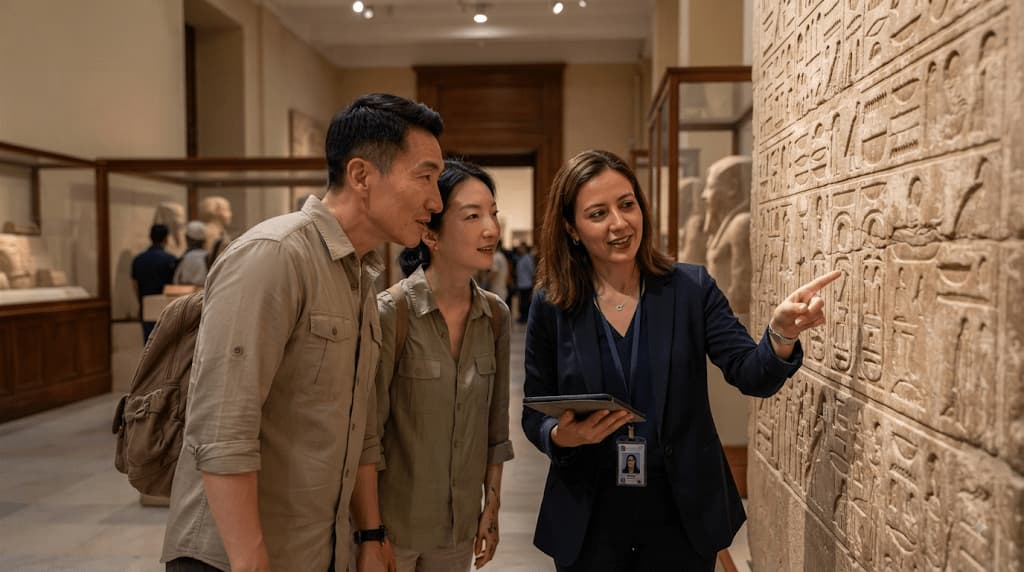
(The couple examining hieroglyphic wall carvings with their guide Nadine at the Egyptian Museum, 8K photorealistic)
At the Papyrus Workshop
How It Becomes Paper
After the museum, Nadine took us to a small papyrus workshop. The owner sat in silence, slicing papyrus stems into thin strips.
When we said hello, he didn't even look up — just gestured for us to sit. Gruff, but the precision in his hands was something else entirely.
Nadine explained the process: the stems are sliced thin, layered in a crisscross grid, then pressed and dried under weight.
Natural adhesive compounds within the plant fibres bind everything together during this process. Chemists studying this binding mechanism have confirmed the fibres can fuse together without any external glue at all.
The Secret in the Pigments
On one side of the workshop sat small bowls of coloured pigment powder. Nadine pointed to each in turn. "This green comes from malachite, this red from hematite, this blue from lapis lazuli.
" When she mentioned that lapis lazuli doesn't even occur naturally in Egypt — it had to travel thousands of kilometres from Afghanistan — my husband's eyes widened.
"They hauled it that far, just to paint a picture?" Nadine nodded. "An obsession with colour, in a way."

(The couple observing pigments and papyrus-making at a small workshop, 8K photorealistic)
The People We Met at the Market
A Girl Humming as She Drew
In a small yard beside the workshop, a young girl was doodling on a leftover scrap of papyrus. Clumsy strokes, but there was something in her colour choices that caught the eye.
When she noticed us watching, she tried to hide her drawing, embarrassed — until my husband gave her a thumbs up, and she broke into a shy grin and kept going.
A Fake-Antiques Seller With a Flair for Theatre
At the edge of the market, a trader held up a bundle of faded paper, insisting it was "genuine ancient papyrus.
" He raised his eyebrows dramatically and declared, "Even museums would want this one!" Nadine leaned in, holding back laughter.
"That's just tea-stained paper. He does this every single time." We laughed and moved on, though you had to admit — his performance deserved some credit.
The Aesthetics Built Into Temple Architecture
Symbolism in a Single Column
Nadine's final stop was a small outdoor exhibit, where she showed us column capitals carved to resemble papyrus and lotus blooms.
"Egyptian temple columns weren't just structural supports. They were a way of bringing nature into the temple itself.
" Architectural historians argue these plant motifs weren't purely decorative — they were part of a religious symbolic system representing life force and renewal.
An Evening, Brush in Hand
Writing Hieroglyphs Together
That evening, on Nadine's recommendation, we joined a small calligraphy class. With clumsy hands, we picked up reed pens and tried writing each other's names in hieroglyphs.
Once my husband finished writing my name, he laughed. "Guess we could get discovered in three thousand years too, then?"
Nadine nearly fell over laughing. Just a few rough sketches, but for that moment, we felt like a small part of this ancient art form ourselves.
Egypt's traditional craft industry — papyrus making, pigment mixing, calligraphy — remains a core livelihood for small workshops across Cairo today.
The silent man making papyrus, the girl humming over her drawing — all of them are part of what keeps this old brush stroke tradition alive.
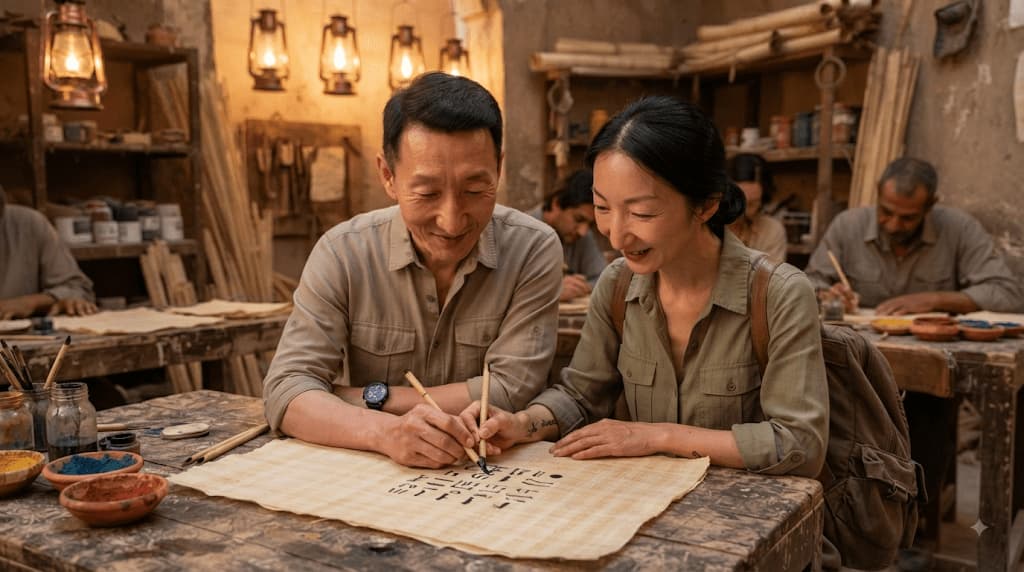
(The couple writing hieroglyphs together at a calligraphy class, warm lighting, 8K photorealistic)
[Today's Egypt Data — Episode 1, Part 9]
Duration of the hieroglyphic writing system: at least 3,000 years, remaining largely unchanged
Papyrus-making process: fibres bond using natural compounds, no external adhesive required
Origin of lapis lazuli: Afghanistan, transported thousands of kilometres to Egypt
[Couple's Discovery Notes]
Husband's one-line verdict: "These people pulled the whole world into a single painting."
Today's biggest surprise: the moment we spotted the "principle of frontality" in Egyptian art ourselves
Tomorrow's task: meeting Egypt's folk tales and Nile legends
[Disclaimer]
This post draws on research into Egyptian art history and archaeology, though the travel episodes, characters, and dialogue have been adapted for readability.
Explanations of specific techniques may represent one of several competing theories.
[Travel expert's one-line comment]
"Egyptian art prioritised information over beauty. Once you understand the rules behind it, the paintings look completely different." — drawing on Egyptian art history research
주소 (골뱅이) gmail (닷) com
반응형