Episode 1, Part 5: Where the Pharaohs Sleep — The Valley of the Kings
If the last chapter had us watching the sunset over the Nile, today we're crossing to the west bank, to the place where the pharaohs chose their eternal rest. Care to come along?
Crossing the Nile that morning, a cool breeze cut across the boat. Fatima pointed west with a small gesture. "The east bank is the city of the living. The west bank is the city of the dead, " she said. That line stayed with me the whole way across.
Kings Laid to Rest Where the Sun Sets
Why This Valley, of All Places
The moment we stepped off the bus, dry rocky hills surrounded us on every side. There wasn't a scrap of shade — the sun sat heavy over the whole valley.
During the New Kingdom period (roughly 1550 to 1077 BCE), pharaohs began carving their tombs into this narrow, out-of-the-way valley, hoping to avoid the tomb raiders.
The limestone here cuts easily and holds its shape well. It felt like the landscape itself had been waiting for this purpose.
Tutankhamun, a Name Left by Chance
Walking a little further into the valley, Fatima stopped and pointed to a small entrance. "This is the one — found in 1922." Most of the other pharaohs' tombs had already been raided in antiquity, but this one had been buried under the debris of another tomb, hidden for thousands of years without anyone knowing.
Fatima asked if I knew what Howard Carter said the moment he first looked inside. "Wonderful things." Archaeologists still repeat that line to this day, she told us.
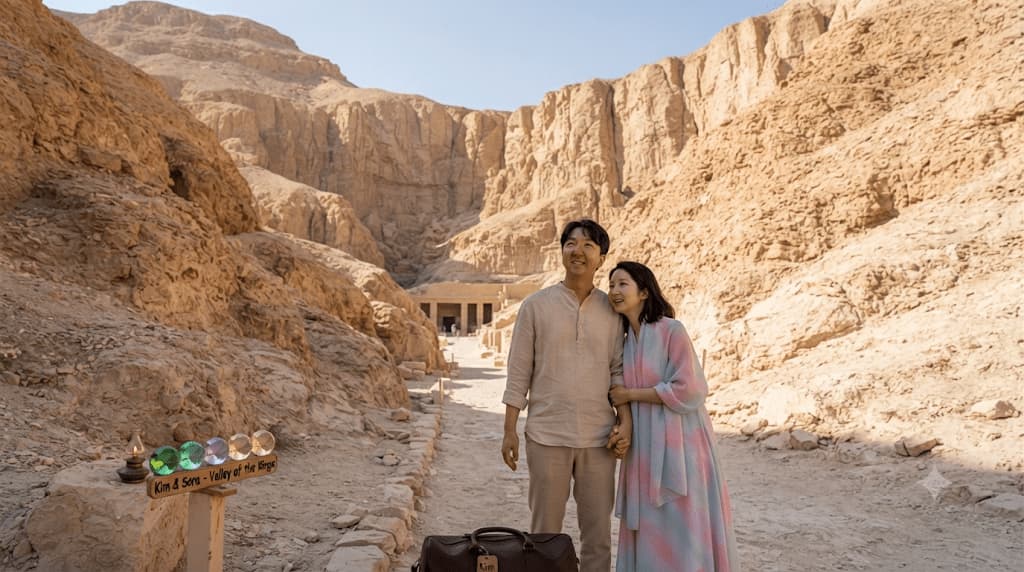
(Entrance to the Valley of the Kings, a narrow path between dry rocky hills, 8K photorealistic)
The People We Met Inside the Tombs
A Quiet Overseer, Standing His Ground
An antiquities overseer stood in front of Tutankhamun's tomb. He didn't say much — just a small gesture to remind people of the photography rules. When we walked over and asked him something, his answers were short and precise.
There was something in that restraint that made you feel the weight of what it means to guard a place like this.
A Guide Who Pushed for a Tip
Inside a smaller tomb, a man who didn't look like an official guide approached us, shining a torch over the wall paintings as he explained them. His explanation wasn't bad, actually.
But as we were leaving, he demanded a hefty tip like it was simply owed to him. It caught us off guard for a moment. Fatima, waiting outside, shook her head once she heard what happened.
"Not an official guide. Stick with me from here on, " she said. It was an uncomfortable moment, but we came away having learnt something — how to tell the real thing from the fake.
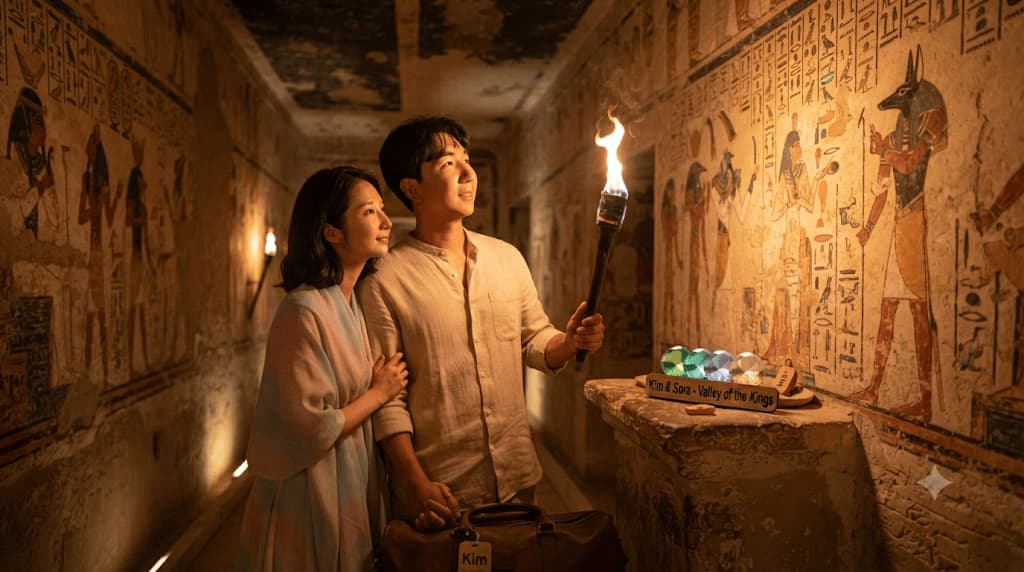
(Inside a tomb in the Valley of the Kings, ancient wall paintings lit by torchlight, 8K photorealistic)
What the Tomb Paintings Have to Say
A Map for the Afterlife
Tiny script covered the tomb walls, packed close together. This was the Book of the Dead — a kind of guide meant to help a soul travel safely through the afterlife.
For ancient Egyptians, death wasn't an ending. It was simply the start of another journey.
Passages Cut with Astonishing Precision
Each tomb had a long passage running deep underground, some stretching past 100 metres. Walking by torchlight alone, what struck me most was how precisely level these narrow corridors were.
Recent surveying studies suggest ancient builders likely used water-based levelling tools to minimise error — remarkable, considering how basic their tools would have been otherwise.
Before Leaving the Valley
Sitting in Silence, Just for a While
Before we left, we sat for a moment on a nearby hill. There wasn't much to say. It wasn't so much the grandeur of the ruins that got to us — it was the thought that, even facing death, people three thousand years ago had prepared so carefully for the ones they loved.
My husband reached for my hand, quiet. "These people weren't even afraid of death. They just got ready to be together anyway." That line stayed with me for a long time after.
The Valley of the Kings is a core pillar of southern Egypt's tourism economy. The funding that goes into excavation and preservation flows directly into jobs for local archaeologists, overseers, and guides. The quiet overseer we met, and even the guide who pushed too hard for a tip — both, in their own way, are part of what keeps this valley known to the world.
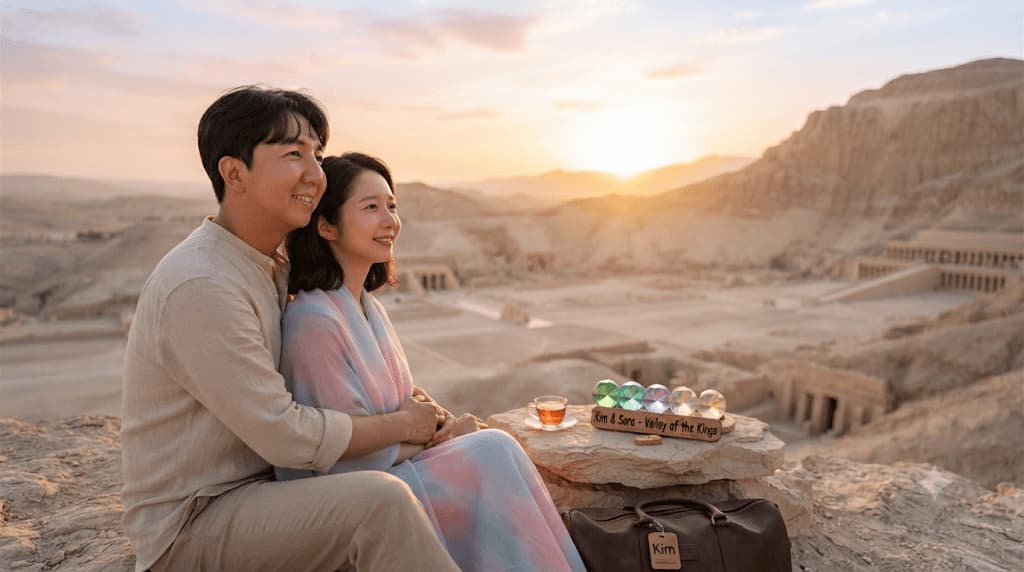
The couple sitting together on a hill overlooking the Valley of the Kings at sunset, 8K photorealistic)
[Today's Egypt Data — Episode 1, Part 5]
Valley of the Kings' main period of use: New Kingdom era (roughly 1550–1077 BCE)
Tutankhamun's tomb discovered: 1922, by archaeologist Howard Carter
Some tomb passages: over 100 metres long
[Couple's Discovery Notes]
Husband's one-line verdict: "This wasn't a place about death — it was a place preparing for the next journey."
Today's biggest surprise: ancient builders used water levels to cut passages with real precision
Tomorrow's task: heading to Abu Simbel to see Ramesses II's temple
[Disclaimer]
This post draws on research into the Valley of the Kings and Egyptian archaeology, though the travel episodes, characters, and dialogue have been adapted for readability.
The episode involving an unofficial guide is included for practical travel awareness only, without any intent to disparage any individual or group.
[Travel expert's one-line comment]
"The Valley of the Kings should be remembered less for grandeur and more for precision — that precision carries the love and belief of an ancient people."
— drawing on Egyptian archaeological research
주소 (골뱅이) gmail (닷) com