Episode 1, Part 3: Eternity Carved in Stone — The Ruins of Giza and Saqqara
If the last chapter had us wandering the lanes of Islamic Cairo, today we're heading back out into the desert to meet the roots of Egyptian civilisation — the ruins themselves. Care to come along?
After our first encounter with the Giza plateau, Hassan suggested we head about 30 minutes south to Saqqara. "You can't say you've seen Egypt if all you've seen is Giza, " he said with a grin. "You need to see Saqqara to understand where it all really began."
The Step Pyramid, Where It All Started
Djoser's Step Pyramid
The moment we arrived at Saqqara, what caught our eye wasn't a smooth triangle but a unique, tiered structure rising in steps.
This is Djoser's Step Pyramid, designed around 2670 BCE by the architect Imhotep — Egypt's first great stone building.
Imhotep's Innovation
Imhotep was no ordinary architect. He's the first named architect in recorded Egyptian history, and he also served as a physician and priest.
What he attempted, for the first time, was building with stone instead of timber or mud brick — and once that attempt succeeded, it laid the groundwork for pyramid construction that would continue for centuries.
Geologists analysing the limestone blocks at Saqqara have confirmed these stones were shipped over by boat from quarries on the opposite bank of the Nile.
My husband looked up at the Step Pyramid and said, "So this was basically the prototype. Like a rough draft of the Giza pyramids." That was exactly the right way to put it.
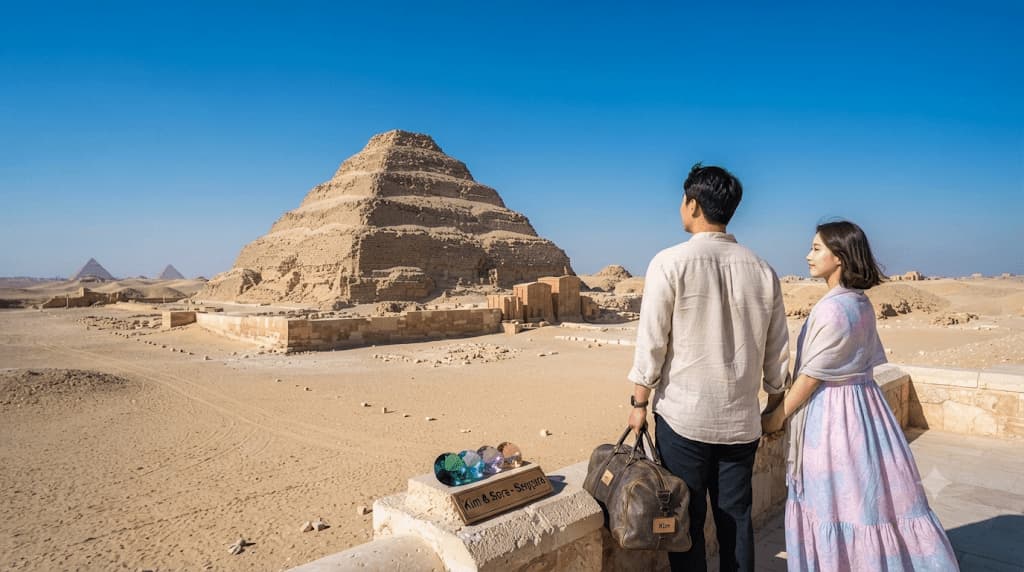
(View of Djoser's Step Pyramid at Saqqara under a clear sky, 8K photorealistic)
The People We Met at the Site
The Quiet Caretaker
As we walked around the Step Pyramid, an elderly caretaker sitting in the shade, fanning himself, caught our eye.
When our eyes met, he gave us a quiet nod hello. He didn't say much, but there was something striking about the calm, unhurried expression of someone who'd been watching over this place for decades.
A Young Man Selling Fake Antiquities
Near the exit of the site, a young man approached us holding a small stone fragment, insisting it was a "genuine ancient artefact." With a very earnest expression, he claimed it was "certified by a museum" and quoted a hefty price.
Hassan leaned in and said quietly, "That's just a recently made souvenir. Genuine artefacts can never legally be sold by individuals — it's against the law."
We politely declined, and the young man moved on to the next group of tourists without much fuss. It was a bit of an awkward moment, but a fun little taste of the haggling culture around Egypt's desert heritage sites.
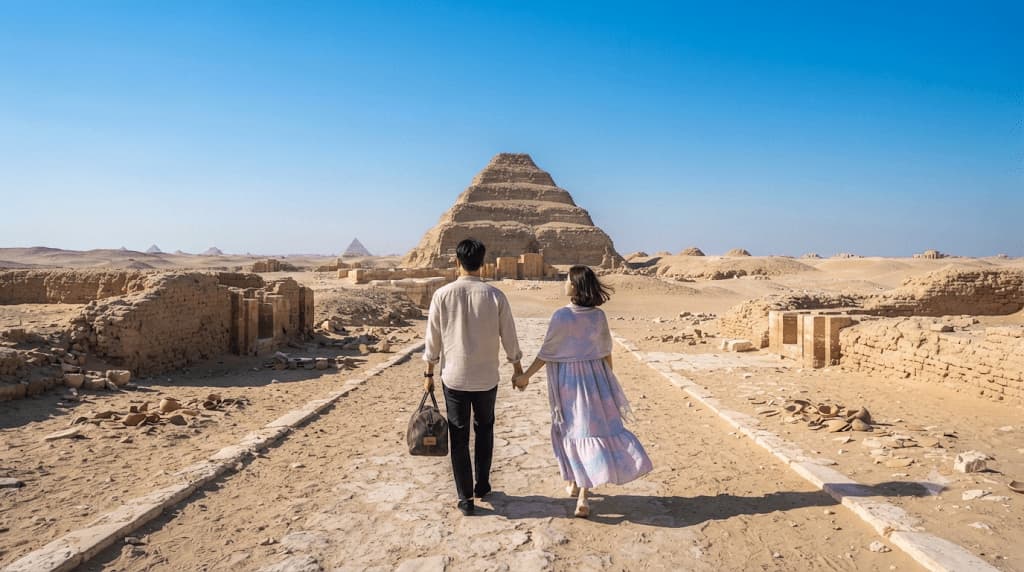
(The couple walking through the Saqqara site with the Step Pyramid visible in the distance, 8K photorealistic)
Tombs That Lead Underground
Mastabas and Burial Culture
Beyond the Step Pyramid, Saqqara is also scattered with rectangular tombs known as "mastabas." This tomb style became the prototype for later pyramid construction, and the walls inside are finely carved with scenes of everyday life at the time — farming, herding livestock, feasting.
Archaeologists analysing the pigments in these wall paintings have confirmed that ancient Egyptians ground minerals like malachite and hematite to create their colours. Remarkably, these pigments have kept their vivid colour after four thousand years, something conservation scientists attribute to the dry desert climate and the sealed environment inside the tombs.
We followed a narrow passage down into one of the tombs to see these paintings up close. Lit by torchlight, the figures looked almost alive, and my husband stood in silence for a long while, just taking them in.
A Quiet Moment of Our Own in the Desert
A Small Celebration Before the Ruins
That afternoon, we sat on a small rise near the Saqqara site and shared some basbousa, a traditional Egyptian sweet we'd brought along.
With our third wedding anniversary coming up, this turned out to be an unexpectedly perfect spot for it. Surrounded by tombs that had stood for over four thousand years, we quietly promised each other more moments like this one, for years to come.
The preservation and upkeep of Saqqara relies on ongoing funding from Egypt's tourism authority and archaeological bodies, and that support flows directly into jobs for local residents — guides, caretakers, souvenir sellers.
The quiet caretaker we met, and even the young man haggling over his "antiquity, " were both part of what keeps this ancient site alive today.

(The couple sharing basbousa on a hill near Saqqara in the afternoon light, 8K photorealistic)
[Today's Egypt Data — Episode 1, Part 3]
Djoser's Step Pyramid was built: around 2670 BCE
Architect Imhotep: the first architect whose name survives in recorded history
Mastaba wall painting pigments: mineral-based (malachite for green, hematite for red)
[Couple's Discovery Notes]
Husband's one-line verdict: "Saqqara is where Egypt's 'first attempts' still survive."
Today's biggest surprise: four-thousand-year-old wall paintings that still hold their colour
Tomorrow's task: heading to Luxor and the Karnak Temple
[Disclaimer]
This post draws on research into the ruins of Saqqara and Egyptian archaeology, though the travel episodes, characters, and dialogue have been adapted for readability.
The sale of artefacts within heritage sites is genuinely illegal, and the related episode is included for cultural context only.
[Travel expert's one-line comment]
"Saqqara isn't flashy, but every beginning of Egyptian architecture lives here." — drawing on Egyptian archaeological research
주소 (골뱅이) gmail (닷) com